Tests Point to a REM-Like Sleep Stage in a Jumping Spider
Behavioral tests in the jumping spider Portia fimbriata point to a REM-like stage of sleep, a new PNAS study with authors from the University of Bonn reports.
Published:
Read time: 4 min
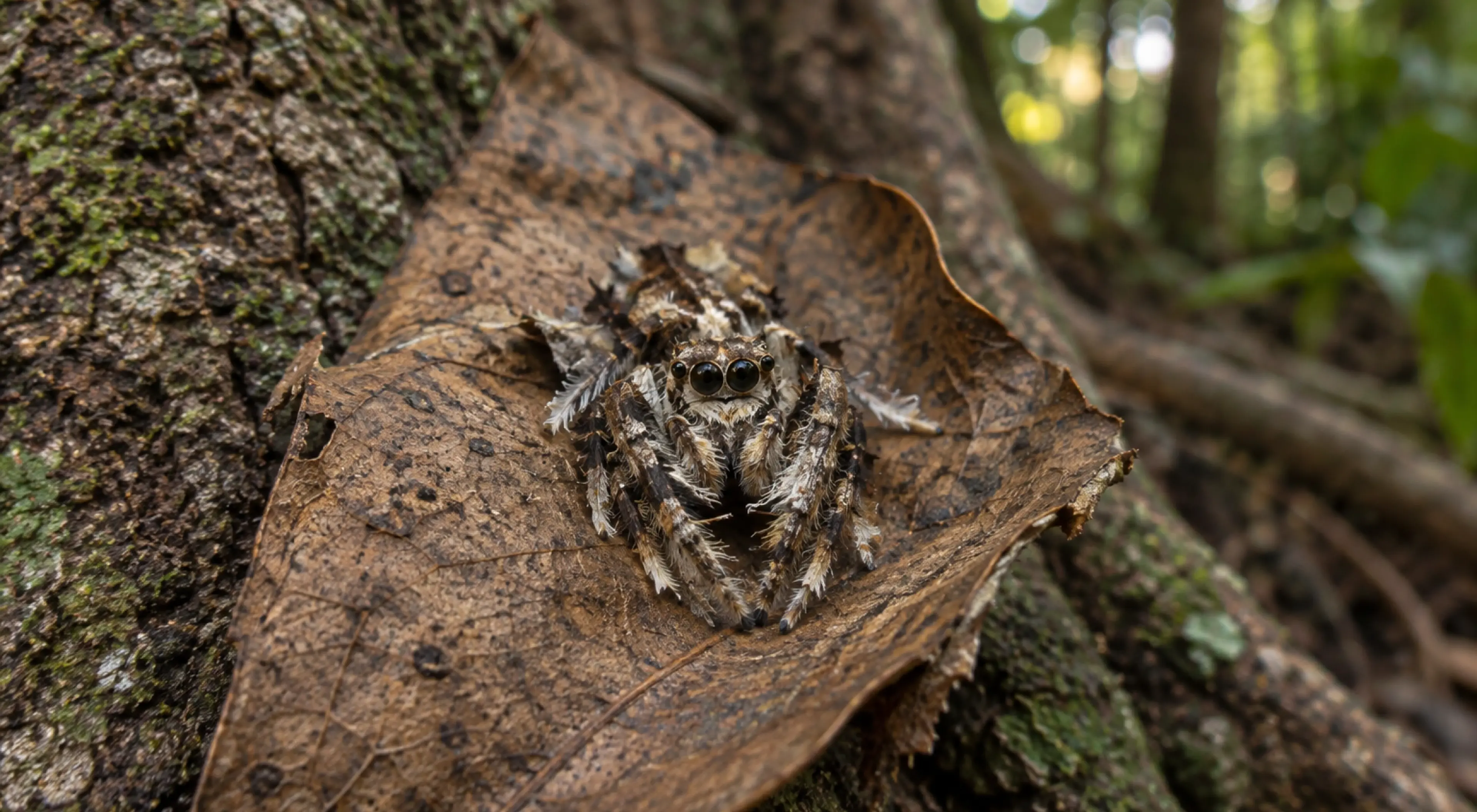
The jumping spider Portia fimbriata is harder to rouse during regularly occurring REM-like episodes, behavioral tests show. A team including researchers at the University of Bonn also tracked the spiders’ daily activity rhythm and what happens after their sleep is interrupted. The authors conclude that the animals show behavioral sleep with a REM-like substate, a phase that resembles REM sleep in vertebrates. The evidence is behavioral, as the paper’s title says.
PNAS published the work on October 26, 2026, and it shows that Portia fimbriata, a jumping spider in the family Salticidae, displays several behavioral hallmarks of sleep. First author Nadja Geiger of the University of Bonn and last author Daniela Christina Rößler, who works at Bonn, are joined by colleagues in Germany, Italy, Australia and the United States.
Why a spider needed a sleep test
Sleep research leans heavily on vertebrates, animals with backbones. The Bonn team says that what we know about sleep comes almost exclusively from vertebrates, so scientists have had little chance to ask whether sleep looks the same in a very different body plan. Spiders are arthropods, animals with jointed legs and a hard outer skeleton, and they sit far from the vertebrates on the animal family tree.
An animal cannot report how it feels, which is why researchers define sleep through observable behavior. The criteria the team tested include a regular daily cycle, a drop in responsiveness, and a need that builds when rest is lost. Those are the kinds of signs the new paper looks for in a spider.
In 2022, a team led by Rößler reported REM-like behavior in another jumping spider, Evarcha arcuata, with parallels to vertebrate sleep. REM stands for rapid eye movement, a stage of sleep in vertebrates, and “REM-like” means the spider’s behavior resembles it. Until now, though, no experiment had shown that these behavioral signs actually represent sleep in spiders.
The paper’s title, “Behavioral evidence for two-stage sleep in spiders,” states the approach. Rather than leaning on one sign, the team checked several behavioral markers together, because a motionless animal is not necessarily a sleeping one.
A daily clock and a structured night
The authors report diurnal activity, meaning the spiders are active by day. They also report a free-running circadian rhythm, a cycle of about a day that continues without outside time cues such as a switch between light and dark.
Think of it like this: a wristwatch in a windowless room keeps ticking at its own pace. A free-running rhythm does the same job inside an animal, which is why it points to an internal clock rather than a simple reaction to sunrise.
Sleep architecture is the third marker, meaning how rest is organized into stages over time. The authors describe a well-defined architecture in which REM-like behaviors occur regularly, so those episodes look like a built-in part of the spider’s rest and not random pauses.
Harder to wake, then sleepier after an interruption
Two further results concern responsiveness. The first is an elevated arousal threshold during the REM-like states. An arousal threshold is the strength of disturbance needed to make an animal react, so a raised one means the spider is harder to rouse. As Geiger puts it, responding slower or not at all to outside stimuli is a hallmark of sleep.
The second is a rebound effect after sleep disruption. Animals deprived of rest tend to recover some of it afterward, and researchers use that pattern to tell sleep from plain inactivity. To disrupt the spiders’ rest, the team put 25 live fruit flies into their enclosures at night. The authors report rebound effects in Portia.
The logic of the rebound test is simple: if a lost stretch of rest were only idle time, nothing would need making up afterward. A spider that does recover rest is behaving as if it had a need for it.
From these results, the authors conclude that the behavior they observed is behavioral sleep. They describe it as evidence for a REM-like sleep substate, a distinct phase within sleep, in a terrestrial invertebrate, meaning a land-dwelling animal without a backbone.
One species, one method, and no dream claim
The work covers one species, Portia fimbriata, so the findings cannot simply be carried over to other spiders or other invertebrates. Whether other jumping spiders, other spider families or other invertebrates show the same two-part pattern is not settled by this paper. The evidence is behavioral, as the title says: the REM-like episodes are identified by what the animals do.
The abstract does not say that spiders dream, and it does not describe what, if anything, a spider experiences during those episodes. The authors themselves say that dreaming is a human concept tied to subjective experience, which makes firm conclusions extremely difficult. The paper also gives no account of the brain or body processes behind the behavior, only of the behavior itself. The authors’ own wording is “REM-like,” a label for resemblance to vertebrate REM sleep, not a claim that the two are identical.
Learn more about animal biology on the Nibble app
In Portia fimbriata, a set of behavioral tests points to rest with two parts, one of them resembling REM sleep in vertebrates. The authors read that pattern as behavioral sleep, reported in a land-dwelling invertebrate far from the vertebrates that dominate sleep research.
Biology covers animal behavior, bodies and daily rhythms on the Nibble app, with lessons lasting between 1.5 and 15 minutes. Readers who found a sleeping spider curious can follow that thread into related facts about how animals and other living things keep their schedules.