Small Study Finds Octopuses Squeeze Through Holes in 3 or 4 Steps
Octopuses squeezed through a small hole in three steps, or four when the opening was tighter, a Journal of Experimental Biology study of three animals reports.
Published:
Read time: 4 min
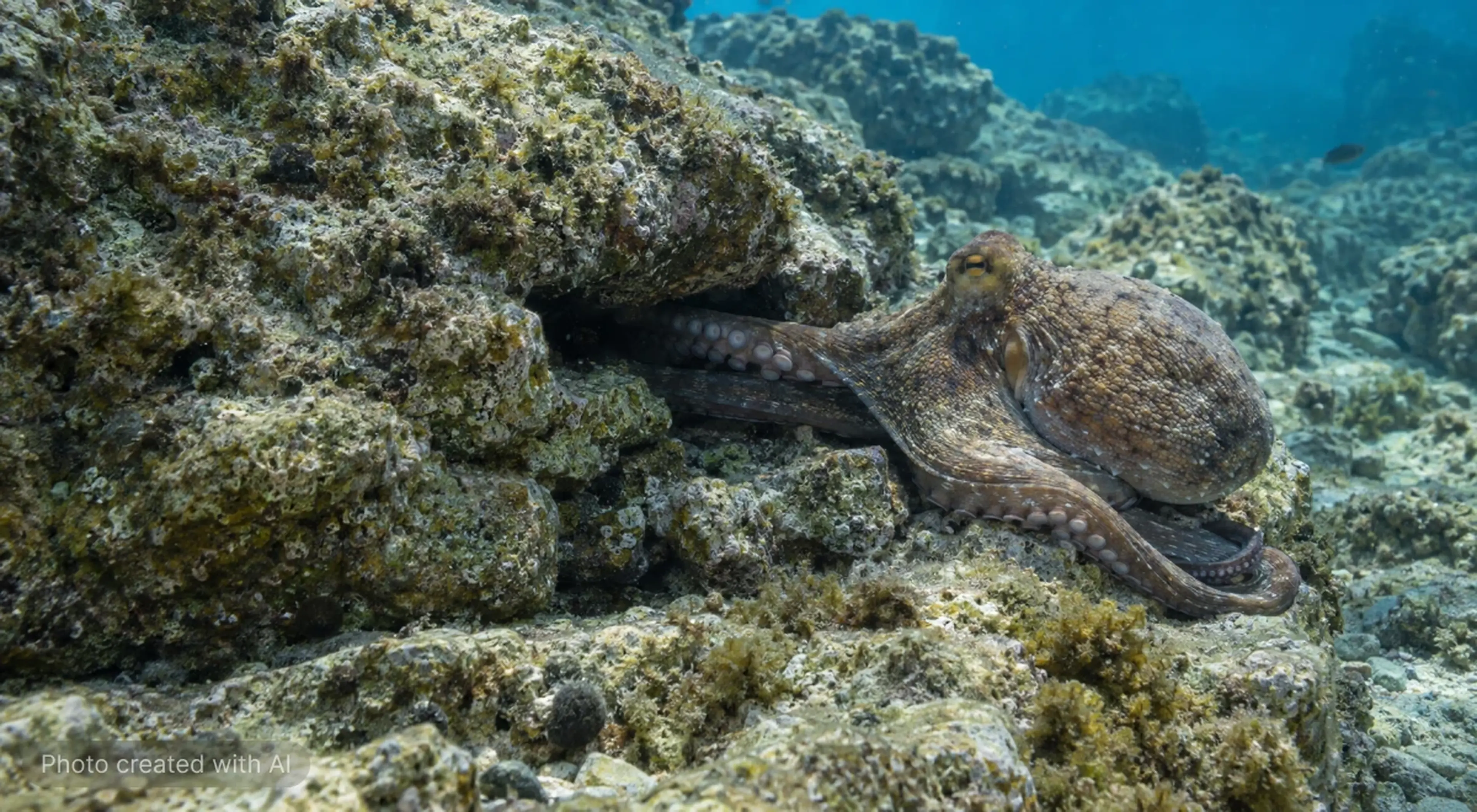
A 30-millimeter (about 1.2-inch) hole was passable for common octopuses with eyes 30 to 35 millimeters apart, but only after they added an extra stage to their routine. Researchers in Singapore, Italy, and Austria filmed three Octopus vulgaris squeezing through a hole in a clear tank partition. Each animal sent arms through first, in a set order, and the body followed. One animal given a relatively larger hole needed only three steps.
Data published in the Journal of Experimental Biology suggests that octopuses pass through small openings by following a consistent sequence of arm movements. The paper appeared online on November 5, 2026, with Wenci Xin of the National University of Singapore and Michael J. Kuba of the University of Naples Federico II as corresponding authors. Video was tracked frame by frame.
One arm probes, then more arms follow
Of 33 recorded trials, 30 entered the strategy analysis, using footage from at least two angles.
The sequence starts with probing. Once an octopus finds the hole, it sends a single arm through to the far side.
Shifting comes next. More arms follow until they fill the opening, leaving the head, several arms, and the mantle (the baggy, muscular part of the body behind the head) on the starting side. Shifted arms numbered three to five, and four was most common, at 14 trials.
With the relatively larger hole (20 mm, or 0.8 in, for an animal with eyes 15 to 20 mm apart), the last step is a single move. The octopus twists two inserted arms and sticks them to the far side of the partition with suckers. Then it stiffens and extends them.
Pushing on the board pulls the remaining arms, head, and mantle through at once, with the two end arms of the shifted group doing the pushing.
Frontal arms did most of the probing and anchoring. Overall, the first two left arms were favored, at 28% and 47%, which the authors say is possibly due to the setup's asymmetry: one side of the tank gave a clearer view outside.
A tighter hole adds a separate step for the body
Probing and shifting looked the same when the opening was smaller than the gap between an animal's eyes. The split came afterward. The animals passed the remaining arms through first (arm squeezing), then the head and mantle in a second move (body squeezing).
During arm squeezing, the octopuses rotated their bodies upward and forced the inserted arms deeper into the hole, which enlarged the space available. The mantle came last.
Think of it like this: climbing through a narrow window by gripping the outside of the frame and hauling yourself in. The octopus grips with suckers and stiffened arms and then pulls its head and mantle after them. Where the comparison stops: an octopus has no rigid skeleton to fold, and side views showed the mantle actively narrowing.
In 3-step trials, duration stayed consistent. In 4-step trials, durations rose markedly over later trials, and every failure came from the same animal. The authors name growth and declining exploratory motivation as possible reasons.
Octopus maya used only the three-step route
The team also tested four 4-month-old Octopus maya. With a 10 mm (0.4 in) hole and eyes 10 to 15 mm apart, they made no attempt to squeeze in during four initial trials, so a systematic analysis was not feasible.
Two more animals then faced a 20 mm (0.8 in) hole and used the 3-step strategy in every trial. Offered a 15 mm (0.6 in) hole between two 10 mm holes, one animal tried a smaller hole first, failed to shift more than two arms, and after several attempts went through the central hole in three steps.
A hint for robot design, from only three animals
The paper notes that search-and-rescue robots often have slender, snake-like bodies. That shape limits their sensing and manipulation. The authors suggest that coordinating simple movements from a higher level, as octopuses may do, could inspire soft-robot control.
That idea is a hypothesis. Xin and colleagues write that "None of these explanations can be fully validated," because the behavior varies across trials. They also say failed attempts suggest octopuses may not accurately judge whether an opening is passable, and that the limit may include the combined cross-section of the arms' proximal areas, not just the beak.
The experiment used three Octopus vulgaris in captivity at the Haus des Meeres in Vienna, each tested at one hole size. The authors say this limited their ability to separate hole size from individual preferences, and the mantle observations are initial. "Further studies should include larger sample sizes and tests with multiple hole sizes," they write.
Learn how eight bendable arms work on the Nibble app
In a Vienna tank, three common octopuses showed a repeatable order of moves: probe with one arm, shift more arms, then squeeze, with the squeeze split in two once the hole shrank below their eye distance. The paper reports the 4-step version only in Octopus vulgaris, from three animals in total.
One arm testing a hole is a small clue to how soft bodies get through tight spaces, and that kind of question about how living things work belongs to Biology on the Nibble app. New lessons arrive every week, and between lessons readers can chat with 10+ historical figures.