Silver Finds Suggest Northumbria Chose Its Copper-Alloy Coins
A Durham University database of ninth-century gold and silver finds suggests Northumbria switched to copper-alloy coins by choice, not because silver ran short.
Published:
Read time: 4 min
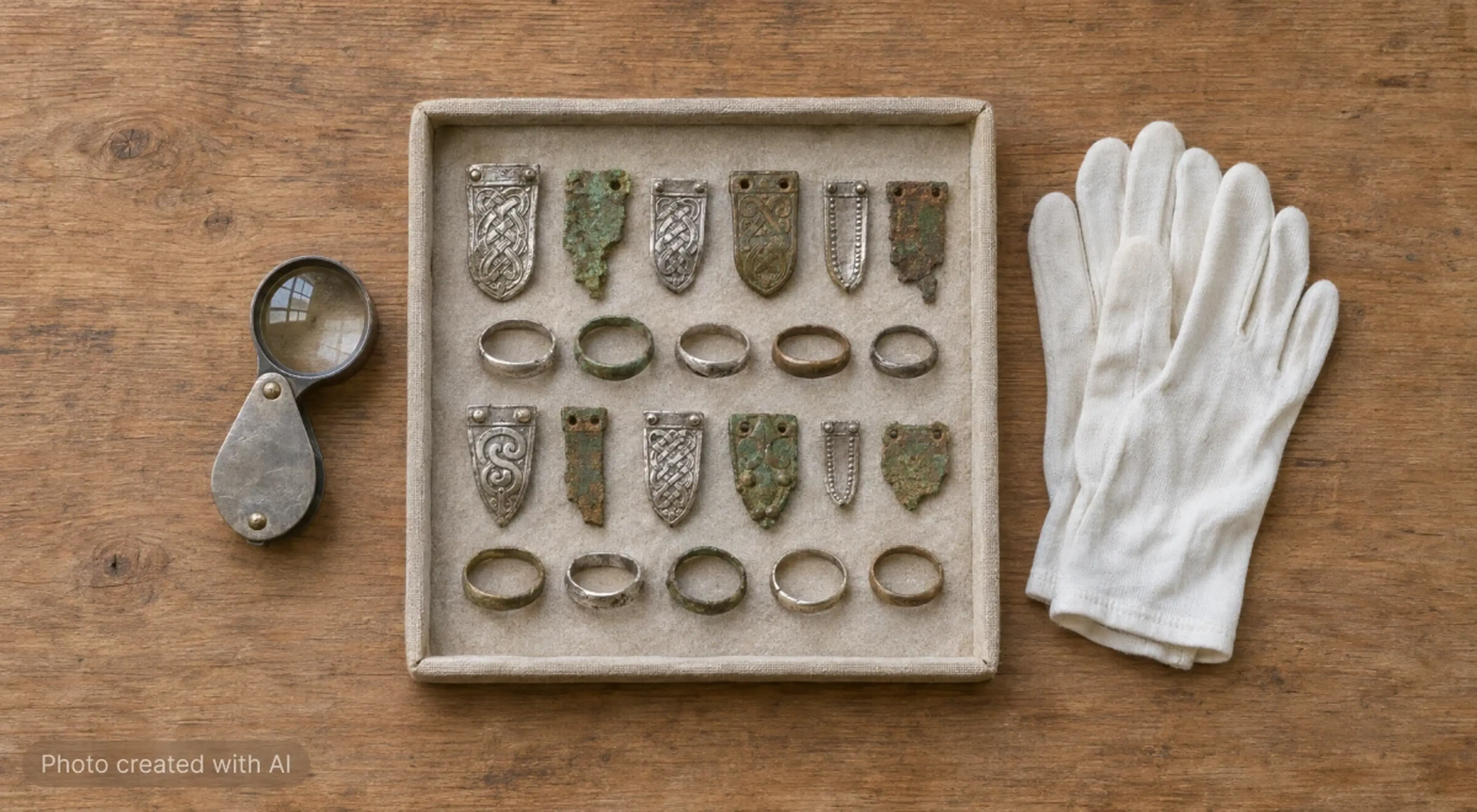
Durham University archaeologist John Luke Carson has tallied the gold and silver objects left in ninth-century Northumbria, a kingdom whose coinage drifted away from silver and ended up copper alloy. His database holds 27 certain and 7 likely silver finds, plus 12 in gold. Carson reads the totals as a sign that the kingdom had metal to spare and chose its copper-alloy coins deliberately, instead of being pushed into them by a shortage.
Writing in Antiquity, Carson, of Durham University's Department of Archaeology, reports that silver was far from scarce when Northumbrian rulers debased their coins, meaning they cut the silver content. The paper, accepted on May 20, 2026, rests on records gathered from published literature rather than new digging. More than half of the finds come from the Portable Antiquities Scheme, a register of objects that members of the public report in England and Wales.
Sorting finds by how sure the date is
Carson defined Northumbria as the territory from the Humber, South Yorkshire, and Lancashire northward. Its northern limit ran along the Firths of Forth and Clyde.
Each find went into one of three tiers. Certain finds are precious-metal objects dated to the ninth century, likely ones probably belong to it, and possible ones have an uncertain date or metal.
Hoards count as one find, different objects from one site count separately, and the conclusions rest mainly on the certain and likely tiers.
The logic works like checking a pantry to learn why a family skipped a dish: full shelves rule out a tight budget. The comparison has limits, since the finds are only objects that survived and were recorded.
Silver in strap-ends, gold in rings
Strap-ends, the metal tips of belts and straps, are the biggest group among the 27 certain silver finds: 14, ahead of 3 finger-rings and 2 hooked tags. Another 23 certain and 8 likely finds are decorated with silver.
The Poppleton hoard, found at York, contained eight silver strap-ends from the ninth century. Every one is bigger than comparable pieces from south of the Humber, and four of them by a wide margin. Hardly the inventory of a kingdom scraping the bottom of the purse.
Carson writes that "silver was not absent from ninth-century Northumbria." Gold is scarcer: 12 finds, 11 certain and 1 likely, eight of them finger-rings, and all gold decoration is gilding.
His 2022 doctoral thesis, updated in March 2025, supplies the eighth-century comparison. It records one likely gold find and none certain, with gold decoration all gilt except one gold-leaf object. The ninth century therefore shows greater access to gold and more silver outside coinage.
Why would a kingdom with silver switch to copper?
Northumbria suffered its first recorded Viking raid at Lindisfarne in 793 and fell to the Vikings in 867. The paper weighs two readings of the ninth century, one of decline and one of economic strength, and Carson's finds fit the second.
He concludes that the kingdom probably debased its coins on its own initiative, not because silver was running out. A shared coinage could have supported social cohesion and a common identity. Profit from minting may have come first, with the flexibility of a lower-value coin recognized later.
Naismith's 2017 analysis, cited in the paper, puts the silver content at up to 40% until later in Eanred's reign, then at 10% at most, with none left during Aethelred II's second reign (844 to 848/9).
Citing his 2022 thesis, Carson says more of the debased coins circulated than of most earlier issues, and copper-alloy coins reached the north and west of Northumbria in quantity, which earlier precious-metal coinages never did.
Where the silver came from is still unclear
The paper judges the silver unlikely to have come from Northumbrian mining. That rests on a 2024 study of twelfth-century coins from northern English and Scottish mints, where North Pennines lead silver appeared in only a small minority of tested coins.
Making the copper alloy took tin, likely from Cornwall, and zinc, likely from the Aachen area, imported on a large scale. Carson says this may indicate substantial involvement by the Northumbrian crown. How the movements of silver, tin, and zinc connect remains unclear.
The finds are unevenly distributed, with most from the south-east of the kingdom, mainly modern North and East Yorkshire, and economies differed within it. Finds were counted, not weighed: some objects mix metals that cannot be separated, and the composition is often unknown.
The possible tier is left out of the main conclusions because its dates, metal content, or presence in Northumbria in the ninth century are uncertain. Adding its silver-decorated finds would not substantially change the picture, as most carry little silver. The silver evidence cannot settle whether profit or the flexibility of a cheaper coin drove the change, or both.
Chase the silver behind Northumbria's coins on the Nibble app
Ninth-century Northumbria's copper coins now sit beside a database of silver and gold objects that points to a kingdom with metal on hand. Carson's reading is that the switch was a decision, though the motive behind it, and the origin of the silver, are still open.
The oversized strap-ends of the Poppleton hoard are one small clue, and History on the Nibble app follows how objects like them connect to the way people lived and traded. Chats with 10+ historical figures are part of it, and lessons open on iOS, Android, or web.