Records Suggest Busy Years Tightened Florence Cathedral Rules
Florence Cathedral's builders got no outside-work permits from 1424 to 1429, and a study by Leonardo Ridolfi links tighter rules to busier years of building.
Published:
Read time: 4 min
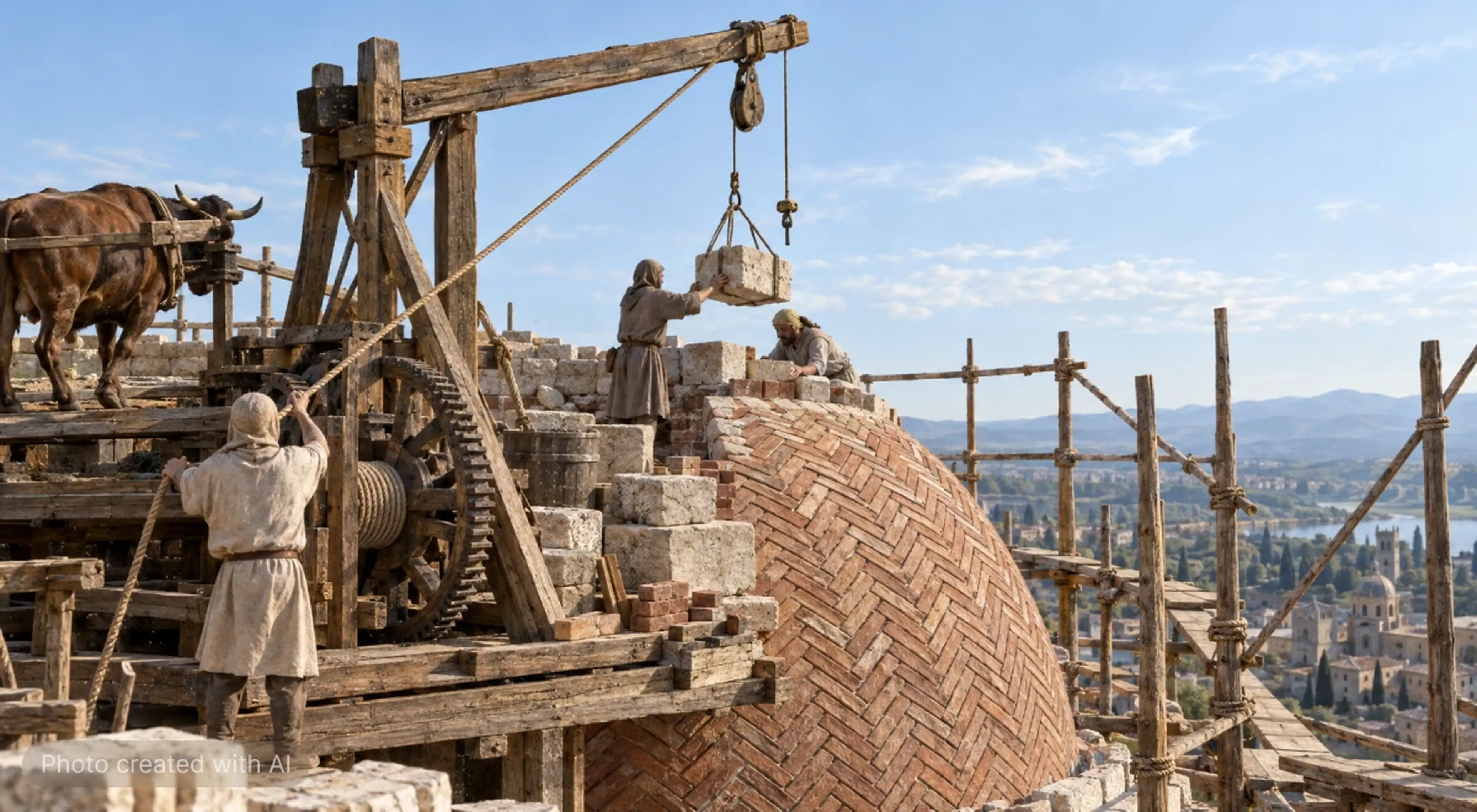
University of Siena economic historian Leonardo Ridolfi has gone through the surviving administrative records of the builders of Florence Cathedral, and the labor conditions they show follow a pattern: the busier the building site, the tighter the leash. From 1424 to 1429, while the summer workforce more than doubled, the records show no permits at all for outside work. In other years, cathedral workers could get leave to build for Florence's leading families.
Data published in the Jahrbuch für Wirtschaftsgeschichte on October 26, 2026, suggest that oversight of the workforce tightened when building activity peaked at the Opera del Duomo, the body that ran the cathedral's construction. Ridolfi, an associate professor of economic history at the University of Siena, analyzed the Opera's provisions for two spans: 1353 to 1382, then 1417 to 1436, which covers Brunelleschi's dome. The Opera relied on fines, dismissals, and a fair amount of flexibility.
Permits for outside jobs shrank as the dome rose
The Opera expected its workers to serve it alone. A 1377 rule fined masters 5 florins for working elsewhere without the wardens' approval, about 23 work days of pay, per the paper. By 1379 the ban covered every worker, and the penalty was dismissal.
Exceptions followed. Between 1417 and 1436, Ridolfi counts 92 provisions on individual requests, and the 44 that state a length run from 1 day to 4 months.
Of the 92, 56 were issued in just four years: 1417 to 1419, before the dome work began, and 1435, near the end. From 1424 to 1429, the workforce more than doubled in summer, and the wardens granted none. Permits returned in 1430, when work on the dome paused, with seven issued.
Rainaldo degli Albizzi requested the most, with at least ten workers over at least 67 days. Permits also served as bargaining chips: Jacobus Borre could work for Braccio, Lord of Perugia, only after releasing the Opera from a prior financial obligation.
Fines replaced dismissal as the usual penalty, and punishments bent
Comparing the two periods, Ridolfi finds a general easing of control, with fines replacing dismissal as the usual sanction, except when demand for labor peaked.
Think of it like this: job control is how closely an employer governs where, when, and how people work. Picture an office that logs badge swipes, wants sign-off for side gigs, and keeps tabs on the supply closet. The Opera did the equivalent with a scribe, hourglasses, and permits, though the comparison breaks at its penalties, which were dismissal and prison.
Enforcement bent, too. In June 1419, an arrest order was issued against the master Jacopo di Domenico for unauthorized work elsewhere, and four days later he was granted permission to work outside again.
In April 1427, masters hired to dig castle moats at Castellina were to be paid more for hard rock, dug the softer ground, and still claimed the higher rate. The wardens ordered 201 lire and 19 soldi seized. Four masters who recorded double their workdays in January 1432 were dismissed.
Falls, rain pay, and payments after injury
Of 73 safety provisions, 41 deal with injuries. Anyone stationed on the dome got one trip down per working day, normally at rest time, and an order of August 18, 1427, put a clock up there to log who was present. Three provisions, dated 1420, 1423, and 1428, kept full wages for crews stopped by rain or snow.
The records hold 34 new injury cases involving 39 workers. The causes were falls from walls, platforms, and the dome, plus falling stones, bricks, or wooden planks. Five deaths are recorded, and only one falls between August 1420 and August 1436, the dome years proper.
Every identified case drew some payment. On July 31, 1433, the Opera paid the laborer Nencio di Matteo Chotingniuola 4 lire, in the wording of its record as translated in the paper, "for 10 days he was sick because a stone fell on his back."
Where cases could be compared, injury severity tracked the size of the payment, and being a skilled master made little difference. Ridolfi cautions that the sample is small.
Whose voice the records carry
The sources are notarial records produced by the Opera, so they reflect the employer's view. Ridolfi sets the rules against the permits actually issued, which show exceptions were possible. He found the provisions through keyword searches in two databases of Opera records.
He reads the low count of recorded injuries as suggesting relatively advanced safety provisions for the time, and says a detailed comparison with other building projects is still missing.
Ridolfi says the evidence lends support to coordination theory, the idea that new technology drives tighter control of labor. He calls for research on how long these measures lasted.
Walk the scaffolds of Renaissance Florence on the Nibble app
Ridolfi's reading of the Opera's records ties stricter control of Florence's cathedral crew to the busiest stretch of dome building. The same records show leave granted, penalties softened, and some payment after every recorded injury.
History is one of 35+ topics the Nibble app covers, and a single lesson lasts between 1.5 and 15 minutes, which suits a quick stop at Brunelleschi's dome between other things. Anyone curious about the people behind famous buildings, from architects to stonemasons, has plenty of past to browse. Architecture is on the topic list as well, for readers who want to follow the buildings themselves.
Browse History lessons about builders and their world on the Nibble app