Deformed 1834 Sixpence Points to a Mint Fault, Lab Tests Suggest
Lab tests on a deformed 1834 William IV sixpence suggest a fault during striking at the mint, though a later squeeze cannot be ruled out, a new study reports.
Published:
Read time: 4 min
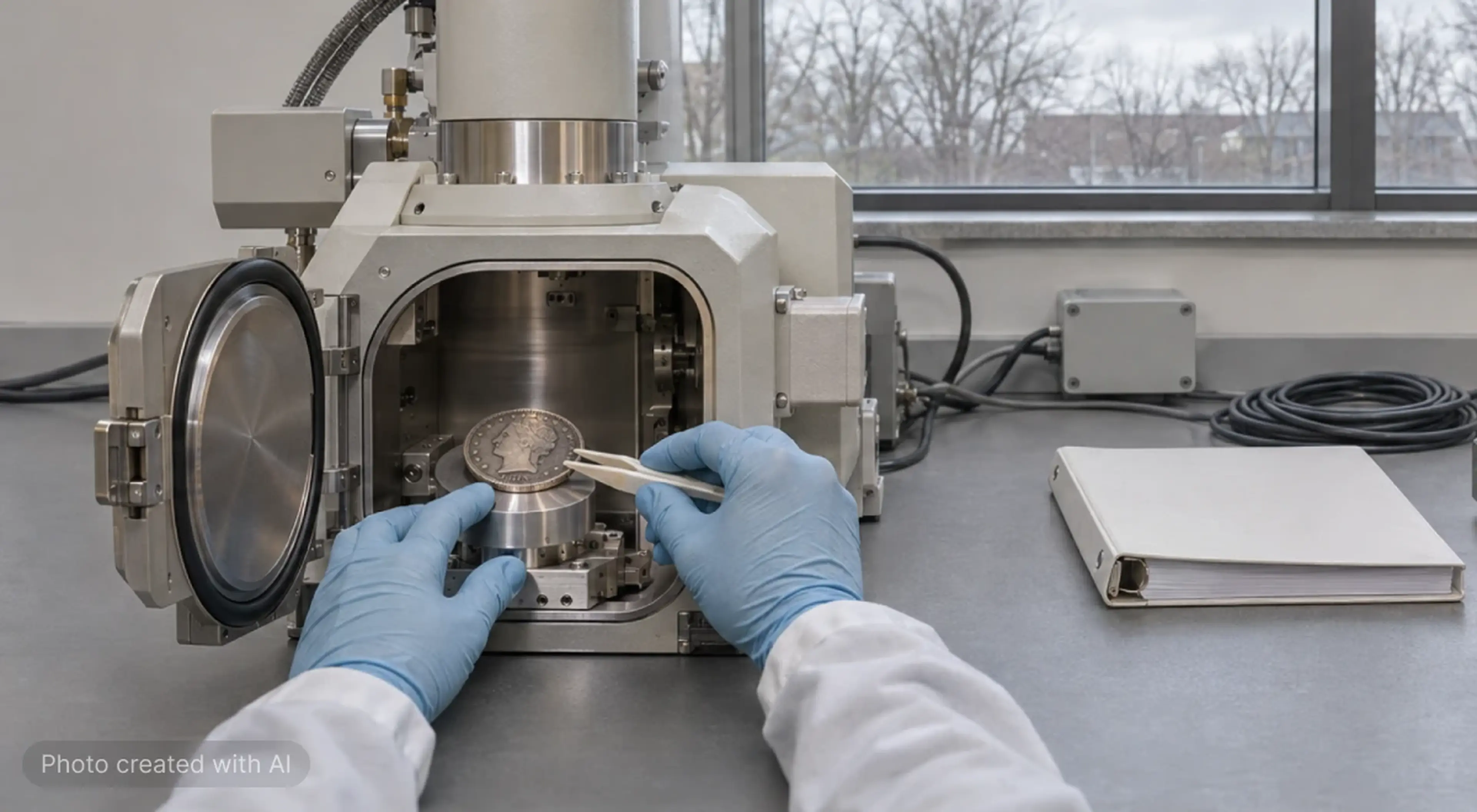
Can a battered 1834 sixpence still tell what happened to it? A researcher in London sent one deformed William IV sixpence to two university labs for elemental analysis and surface scanning. Both faces are crushed at the center, but the outer rim largely survives. The results fit a severe fault during striking at the mint better than wear, corrosion, or a single later knock, though a later squeeze cannot be excluded.
The study, published in npj Heritage Science on September 24, 2026, points out that badly damaged coins from the steam-press era were ordinarily pulled at mint inspection and remelted, so a survivor may keep a record of a brief striking event. A. Ikraam of IA STUDIO, an independent heritage science group in London, tested one William IV sixpence and wrote the paper alone. Brunel University London and the University of Oxford ran the lab work on commission.
Electron beams find silver under the grime
Before any lab time, Ikraam photographed the coin in high resolution and listed the suspects: circulation wear, corrosion, deliberate tooling after minting, a single impact, a later squeeze, and a fault during striking. The tests were meant to cross them off.
At Brunel University London, a scanning electron microscope probed ten spots and patches, six on the obverse (the portrait side) and four on the reverse. Each element gives off X-rays at its own energies, so a detector can list what a surface contains. The method is called SEM-EDX.
Comparatively intact areas gave 87.99 to 95.39 weight percent (wt%) silver on the obverse and 95.65 to 97.08 wt% on the reverse, with a few percent copper. That is broadly compatible with sterling, the 92.5 percent silver, 7.5 percent copper alloy used for 19th-century British silver coinage, though surface readings are not a precise assay.
The crushed centers read differently. Silver fell as low as 24.64 wt% on the reverse, where copper reached 13.12 wt%, and silicon, aluminum, iron, calcium, sulfur, and chlorine appeared. Ikraam reads these as clay-like grit, carbonate, and corrosion packed into the pits, not as part of the alloy.
No spectrum showed a foreign metal inserted into the coin.
Height scans show steps, troughs, and a sharp-sided pit
An optical profilometer works like a surveyor for very small landscapes: a sensor records the height at a grid of points, and the result is a contour map. At the University of Oxford, the obverse scan covered about 7.0 by 6.7 millimeters (about 0.28 by 0.26 inches) around the portrait center and logged 4,966,200 height points.
From the raw grid, Ikraam calculated that the lowest and highest points differ by about 750 micrometers (0.75 mm), with an average height deviation of about 67 micrometers. A micrometer is a thousandth of a millimeter. Even by the standards of pocket change, this was a rough day.
A line across the patch shows a sharp-sided depression with raised shoulders. Curved troughs and terrace-like steps ring it. The reverse has a broad disturbed zone across the crown and denomination, with overlapping displacement while parts of the rim and wreath hold on. On that face, the denomination lettering is largely effaced.
Ruling out wear, corrosion, and a later knock
Wear smooths a surface diffusely, which does not match steep-sided troughs. Corrosion alone cannot raise that relief, and corrosion products sit on top of structures that were already deformed. A single unconstrained later impact fits the evidence less well.
Ikraam concludes the data are "most consistent with a severe mint-stage striking anomaly", meaning a fault while the coin was struck. In the paper's reading, the coin took repeated high-pressure loading while its edges were at least partly held in place.
Crash investigators work the same way: list every suspect, then let the wreckage downgrade them one by one. In this case the wreckage was a coin.
One coin, no archive, and a later squeeze not excluded
The paper is a single-object case study, so it does not establish how often comparable failures happened. No cross-sections were cut, no bulk chemical assay or elemental mapping was run, and no archive records the striking itself. The SEM-EDX results are surface-based, and no unaffected obverse field was profiled for comparison.
Ikraam writes that a later constrained compression "cannot be excluded absolutely", and that the evidence narrows the range of plausible scenarios without allowing a unique reconstruction. The raw datasets are not public but may be available on request.
The paper also states that AI tools helped organize notes and prepare the manuscript but produced no measurements or conclusions. As a template, the non-destructive workflow is aimed at other puzzling deformation in metal heritage objects.
Compare clues from coins and relics on the Nibble app
Laboratory tests on one deformed 1834 sixpence favor a fault during striking at the mint as the cause of its flattened center, with a later squeeze still possible. Surface silver readings and a height map of the damaged zone did the sorting, and the coin stayed intact.
Find more object-led detective stories in the History topic on the Nibble app, since one worn coin can open onto a whole era and the people who handled it. Each lesson can be read, watched, heard, played as a game, or talked through in a chat. You can pick it up on an iPhone, an Android phone, or in a web browser.