Chinese Characters May Be Square Thanks to Many Factors, Not One
Chinese characters settled into near-square cells through several interacting conditions, from brushes to bamboo slips to printing, a 2026 analysis argues.
Published:
Read time: 4 min
Chinese characters fill near-square cells because of several conditions that built up over centuries, not because of one cause. That is a messier answer than the usual suspects offer: the logic of meaning-based writing, a cultural fondness for squares, or the simplicity of the shapes. Two researchers in Wuhan, China, weigh each of those against the history of the script, from bronze inscriptions to printing, and find that none carries the explanation alone.
Analysis published in the International Journal of Arts and Technology reveals that the square emerged through gradual regularization of clustered graphs. Man Dai of the School of Public Art at Wuhan Institute of Design and Sciences and Haiping Li of the School of Visual Arts and Design at Hubei Institute of Fine Arts put it online on October 23, 2026. They draw on published linguistic and paleographic studies, not new excavations.
Shape and meaning are separate questions
Dai and Li start by splitting the puzzle in two. One question is which unit of language a character stands for. The other is why its outline settles into a square.
Think of it like this: what a stamp is worth is one question, and why stamps share a standard small shape is another, and answering the first does not answer the second. The comparison stops there, because the paper describes a gradual process in China, not a single decision.
The authors list four units a square could be built around: a single sound (phoneme), a syllable, a morpheme (the smallest piece of meaning), or a whole word. Each needs certain conditions, and syllable squares are hard in inflectional languages, where word endings keep changing. Korean Hangul, which stacks letters into syllable blocks, is their example of a syllable-unit square.
Early Chinese was mostly monosyllabic and isolating, meaning words stayed one syllable long and did not change form. That left three options open: syllable, morpheme, and word units.
The authors also set three popular explanations aside as sole causes. Hieroglyphic and Dongba scripts build characters from meaning yet are not square, and alphabets are simpler yet not square either. Every script also experiments with arrangement.
Brushes, bamboo slips, and the clerical turn
Early Chinese characters had complex components and mostly curved strokes. Writing in ruled squares appears on the Western Zhou Da Yu Ding inscription, but the characters varied in size and spilled over the lines. The King Zhongshan bronze inscriptions have regular outer contours, yet the position of each character's core still varies.
The authors call the clerical transformation the turning point. Strokes became short and followed eight directions, and components adapted to their slot: the tree component 木 turned tall and narrow in left-right characters and flat in top-bottom ones. Early clerical script still produced varied outlines, while Han clerical and regular script were dominated by a regular square.
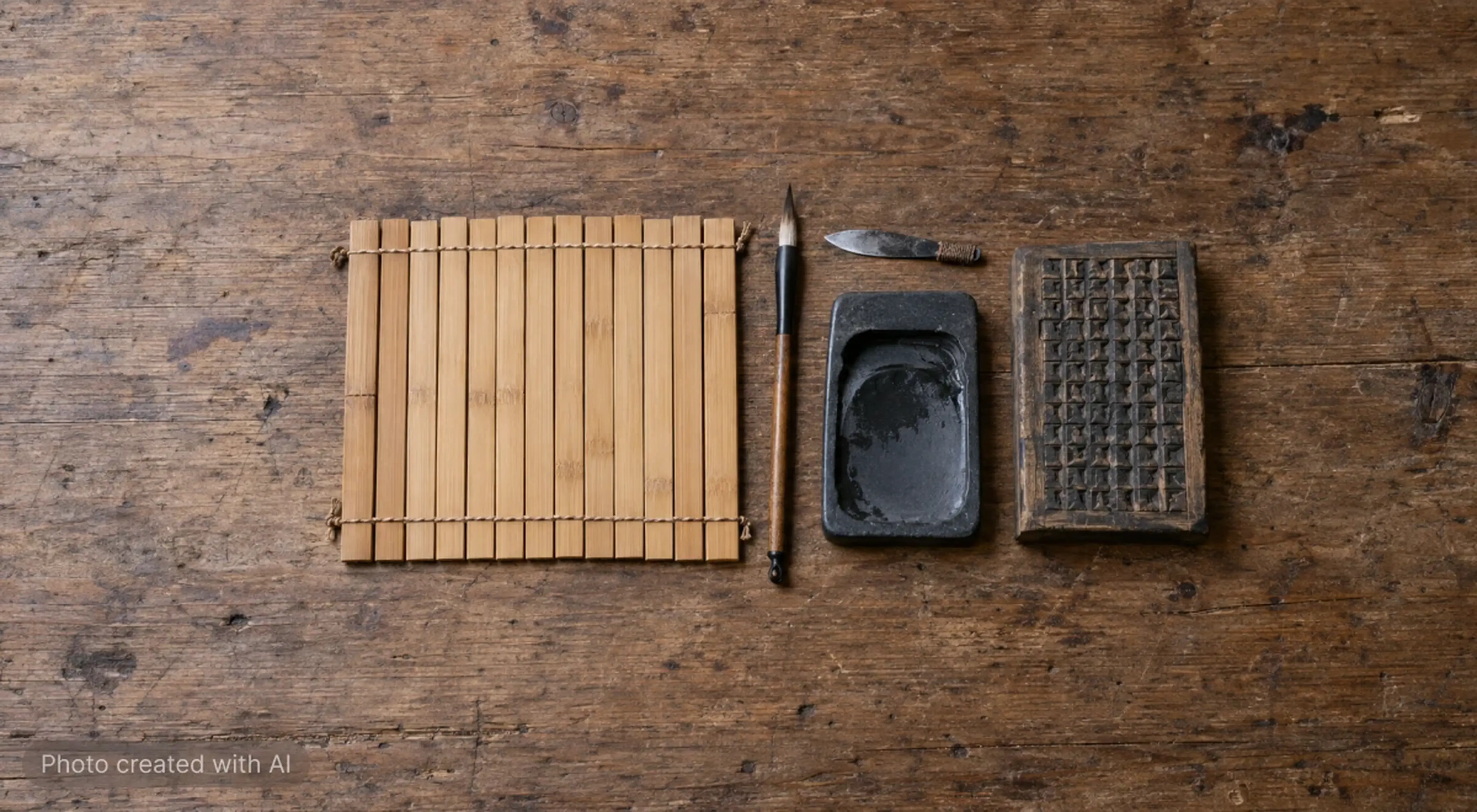
Materials entered the picture too, the authors say, since the brush suits clustered forms. Excavated bamboo slips bearing writing are mostly 0.6 to 0.7 cm (0.24 to 0.28 inches) wide, and the narrowest is 0.3 cm (0.12 inches). Writing vertically on strips that thin, they argue, was more compatible with square forms than with long, linear glyphs.
Characters such as 校, 典, and 刖 show components omitted or moved, changes the authors say likely contributed to the square.
Cultural preference and printing as reinforcement
For contrast, the paper turns to Egyptian hieroglyphs. Their phonological complements let a glyph's length vary, which made a uniform square unlikely. Chinese, the authors say, might have gone another way.
Cultural ideas get a part, but as reinforcement. The Round Heaven, Square Earth conception and the "two cords and four hooks" diagram are linked to the later Mi-pattern and nine-square grids. The paper says the square may be regarded as a cultural choice, though such preferences may have strengthened the convention rather than started it.
The authors also name four formal advantages: a layout that converges on the center suits meaning-based construction, it uses space efficiently, it allows vertical, horizontal, and diagonal text, and it fits visual perception. Movable type then largely removed earlier variability and stabilized the square further.
Qualitative evidence, so no ranking of the factors
The paper has no sample and no measurements of effects. It is a conceptual, comparative study built on published scholarship and selected examples. Those examples test whether a story is historically plausible, not how much each factor weighed.
Terms such as "enabling condition" signal compatibility with events, not necessity. Comparisons with other scripts are heuristic. Dai and Li conclude that the square configuration was "neither an automatic consequence of semantic writing nor a purely cultural preference."
They frame the work as "a testable historical-design hypothesis." A stronger causal account would need a corpus sorted by period, measured glyph proportions and component placement, and matched comparisons across writing systems.
Meet the brushes and bamboo behind writing on the Nibble app
The near-square shape of Chinese characters, the paper concludes, grew from the structure of the language, the habits of brush and bamboo, and later printing, with cultural preference joining in as reinforcement. How much each of those weighed is still untested.
Trace how brushes, bamboo slips, and movable type shaped written characters, and where other scripts took a different path, in the History lessons on the Nibble app. Choose among text, video, audio, games, and chats, five formats in all, whichever suits the moment. The app works on iOS, Android, and web.