Carrion Crows Decide in About 235 Milliseconds, Study Finds
Carrion crows reported choices in a classic visual motion task in about 235 milliseconds on average, roughly double the speed reported for monkeys or humans.
Published:
Read time: 5 min
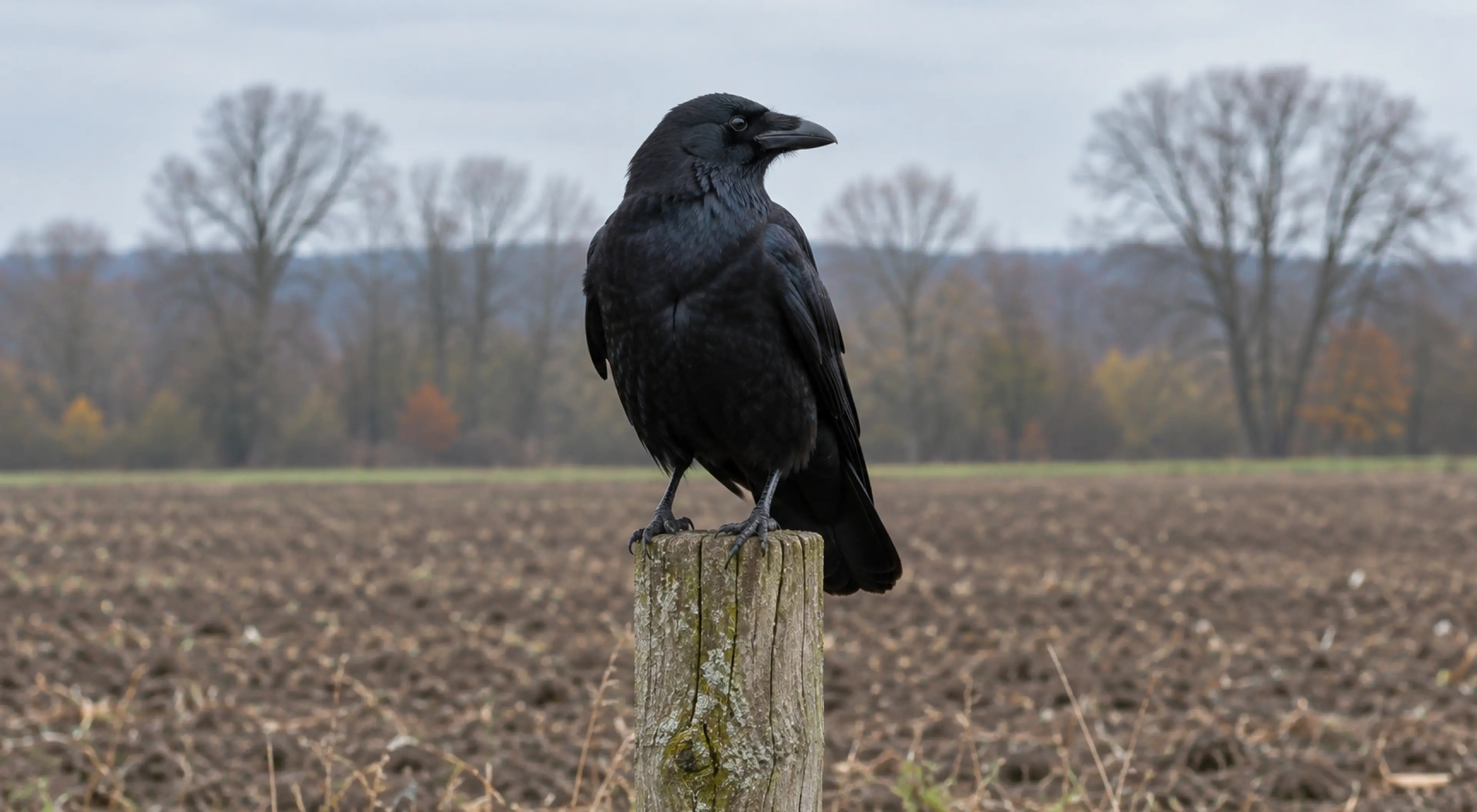
Picture this: a moving pattern appears before a carrion crow, and about 70 milliseconds later, neurons in the bird’s endbrain already signal which way its decision will go. The response follows roughly 170 milliseconds after that signal. Andreas Nieder and Philipp Schmidbauer, both at Tübingen University, report that two carrion crows averaged about 235 milliseconds on a classic motion task, around double the speed reported earlier for monkeys or humans.
Experiments described in Science show that two carrion crows (Corvus corone) can report a choice in a visual motion discrimination task, which asks an animal to judge the direction of movement, while staying highly accurate. The paper, titled “Ultrarapid decision-making in an avian brain,” was published on October 22, 2026. Schmidbauer and Nieder also recorded neural activity from the pallial endbrain, a region of the bird forebrain, while the crows made their choices.
A motion test that monkeys and humans had already taken
Perceptual decision-making is the process of turning something you see into a choice, such as judging which way a pattern is drifting and acting on it. Researchers have studied it closely in mammals. In other vertebrates (animals with a backbone), the authors say, how it works has been unclear, and the crow experiments target that gap.
The test is a visual motion discrimination task: the animal watches movement and reports its direction. In this version, the crows watched a cloud of white dots on a touchscreen and pecked a target on the left or right to match the dots’ main direction. The authors call the task classic, and monkeys and humans have already been measured on it. That gives the crows’ timing a set of earlier numbers to be compared with.
The crows averaged about 235 milliseconds per choice. A millisecond is one thousandth of a second, so the whole decision, from stimulus to report, fit well inside a single second. The authors put that at roughly twice the speed seen for monkeys or humans, and they use the word ultrarapid in the paper’s title.
Speed alone would be a modest result, since quick answers often carry more errors. The authors report that the crows did not sacrifice accuracy: with clear motion they got nearly every trial right, and even on hard trials they beat random guessing. Fast and right at the same time is the part that makes the number worth a second look.
Endbrain cells held the answer about 170 milliseconds early
While the crows worked, the team recorded from 248 neurons in the nidopallium caudolaterale, part of the pallial endbrain that researchers consider comparable to the prefrontal cortex in humans and other primates. The pallium is the upper part of the vertebrate forebrain, and in mammals it includes the cortex. That overlap gives researchers a point of comparison between bird recordings and the mammalian work. The recordings were made while the crows did the motion task, so the neural data and the timing data come from the same choices.
Direction-selective neurons are cells that respond most to one direction of motion: some fire more for rightward movement, others for leftward. In the crows, these cells encoded the upcoming choice as early as about 70 milliseconds into the stimulus, which is about 170 milliseconds ahead of the response.
The recordings also showed ramping activity, in which firing rates climb over time. In decision research, a ramp like this is usually read as evidence building up until a choice is reached. Here the ramping scaled with sensory evidence (how clear the motion was) and converged at response onset.
Think of it like a set of progress bars: clearer motion changes how fast each bar fills, and every bar reaches its end at the moment the response starts.
Evolution is a proposed explanation, not a tested one
The authors conclude that avian decision-making circuitry is extraordinarily efficient. They suggest the speed was possibly shaped by evolutionary pressures for rapid visuomotor control, meaning the coordination of vision with movement that a bird needs to steer in flight. Nieder points out that flight places heavy demands on visual processing and that birds must also react quickly to moving objects and capture prey. That is a hypothesis. The timing data and the neural recordings are the findings.
The speed comparison sets the crows against figures from earlier work in monkeys and humans, so it pits one dataset against others rather than reporting a single shared experiment.
Recordings show what neurons do while a choice is made. They do not by themselves show that those neurons cause the choice. The ramping pattern is likewise an observation in the recordings, and reading it as evidence accumulation follows the usual convention in decision research.
The work also covers just two birds of a single species, the carrion crow, so it is a small sample, and whether other crows or other birds match these timings is not part of the reported findings. All of the recordings came from one brain region, the pallial endbrain, so activity elsewhere in the bird brain is not described.
Find more interesting facts about biology on the Nibble app
Two carrion crows made quick visual choices in a motion test while staying highly accurate, and endbrain neurons signaled each upcoming choice well before the response began. The finding adds a bird to a research area long centered on mammals.
A choice signal that appears about 70 milliseconds after a stimulus is one small slice of how living things work, and that wider question is the ground Biology covers on the Nibble app. Anyone curious about brains, birds, or bodies can start there. Readers can also talk with more than 10 historical figures in chats, and the app is available on the web, Android, and iOS.